

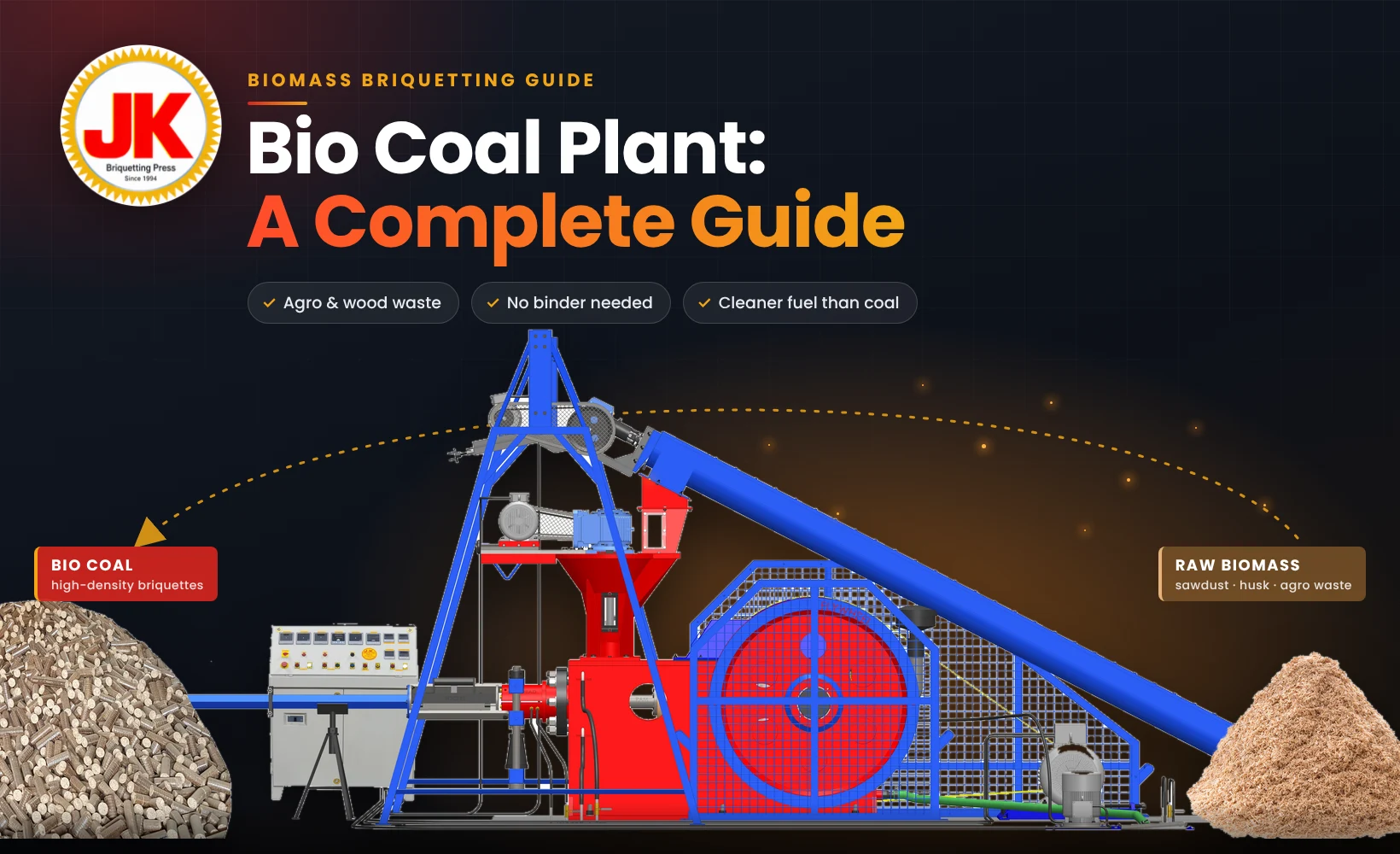
The demand for clean and affordable energy is growing across the world. Many industries are looking for ways to reduce their dependence on traditional coal and other fossil fuels. A Bio Coal Plant offers a practical solution by converting agricultural waste, wood waste, and other biomass materials into solid fuel.
Bio coal is a renewable fuel made from organic waste materials. It can be used in industrial boilers, furnaces, and heating systems. A bio coal plant helps businesses manage waste while producing a useful energy source.
With growing interest in sustainable manufacturing, bio coal production has become an important part of the biomass energy industry. These plants help reduce waste, support energy production, and create business opportunities.
What Is a Bio Coal Plant?
A Bio Coal Plant is an industrial facility designed to convert biomass waste into solid fuel products, mainly biomass briquettes. Some facilities also use advanced processes to produce torrefied biomass, which has properties closer to conventional coal.
The plant processes raw biomass materials using machines that prepare, dry, grind, and compress the material into a uniform shape.
Common raw materials used in a bio coal plant include:
- Sawdust and wood chips
- Rice husks and rice straw
- Groundnut shells
- Cotton stalks
- Sugarcane bagasse
- Mustard stalks
- Corn cobs
- Forestry waste
- Other agricultural residues
Instead of burning these materials in open fields or allowing them to go to waste, manufacturers can convert them into useful fuel.
The finished bio coal briquettes are easier to handle, store, and transport than loose biomass. They also provide a more consistent fuel supply for industrial applications.
How Does a Bio Coal Plant Work?
A bio coal plant follows several steps to convert raw biomass into usable fuel. Each stage plays an important role in maintaining product quality and production efficiency.
1. Raw Material Collection
The first step is collecting suitable biomass materials from farms, sawmills, agricultural processing units, and other sources.
Raw materials must be checked for unwanted objects such as stones, metals, and plastic. Clean biomass helps protect the machinery and improves the quality of the finished fuel.
2. Raw Material Preparation
Biomass waste comes in different shapes and sizes. Large pieces of wood, crop residues, and other materials must be reduced to smaller particles before further processing.
Wood chippers, crushers, and hammer mills are commonly used for this purpose.
Proper material preparation allows the briquetting equipment to operate more efficiently.
3. Moisture Reduction
Moisture content is an important factor in bio coal production.
Biomass containing too much moisture may produce weak briquettes and reduce manufacturing efficiency. A biomass dryer is used when the material needs additional drying.
The required moisture level depends on the raw material and briquetting technology. Many conventional briquetting systems operate best with feedstock moisture around 8% to 12%, although machine requirements vary.
4. Grinding and Size Reduction
After drying, biomass may pass through a hammer mill to produce smaller, more uniform particles.
Uniform particle size helps improve compression and supports the production of strong briquettes.
Grinding also makes the raw material easier to feed into the briquetting machine.
5. Briquetting Process
The prepared biomass enters a briquetting press machine.
The machine applies high pressure to compress loose biomass into dense solid briquettes. In many systems, pressure and friction generate heat that helps the natural lignin in biomass bind the particles together.
This means many biomass briquettes can be manufactured without adding chemical binders.
The shape and size of the briquettes depend on the machine and production requirements.
6. Cooling and Packaging
Freshly produced briquettes may be hot after compression. They need proper cooling before handling and storage.
Once cooled, the briquettes can be packed or stored in a dry area.
Proper storage helps protect the fuel from moisture and maintains its quality.
Main Equipment Used in a Bio Coal Plant
A complete Bio Coal Plant requires different machines that work together to process biomass materials.
Biomass Briquetting Machine
The briquetting machine is the main equipment used in the production process.
It compresses prepared biomass into solid briquettes. These machines are available in different production capacities to meet small-scale and large-scale industrial requirements.
Hammer Mill Machine
A hammer mill reduces biomass into smaller particles.
It is commonly used to process agricultural residues, wood waste, and other materials before briquetting.
A properly selected hammer mill supports consistent particle size and smooth material processing.
Biomass Dryer Machine
A biomass dryer removes excess moisture from raw materials.
Drying improves the suitability of biomass for compression and helps reduce production problems caused by wet material.
Wood Chipper Machine
Wood chippers are used to reduce branches, wood pieces, and similar materials into smaller chips.
These chips can then undergo further processing before entering the briquetting system.
Conveyor System
Conveyors move materials between different machines.
They reduce manual handling and support a continuous production process.
Dust Collection System
Dust collection equipment helps control airborne particles generated during grinding and material handling.
A well-designed system supports workplace cleanliness, equipment performance, and safe operations.
Benefits of Installing a Bio Coal Plant
A bio coal plant offers several advantages for businesses involved in biomass processing and industrial fuel production.
1. Converts Waste into Valuable Fuel
Agricultural and wood-processing industries generate large amounts of organic waste.
A bio coal plant converts suitable residues into useful solid fuel instead of allowing them to accumulate or be openly burned.
This creates economic value from materials that may otherwise have limited use.
2. Supports Renewable Energy Production
Biomass is a renewable energy resource when it comes from responsibly managed sources.
Using biomass briquettes can reduce dependence on fossil coal in suitable industrial applications.
However, the overall environmental benefit depends on feedstock sourcing, processing energy, transport, and combustion efficiency.
3. Reduces Biomass Storage Space
Loose biomass often requires significant storage space because of its low bulk density.
The briquetting process compresses biomass into dense, uniform products.
These briquettes are easier to stack, store, and transport.
4. Creates Business Opportunities
A bio coal plant can create commercial opportunities for entrepreneurs and manufacturers.
Agricultural residues can be purchased or collected, processed into briquettes, and supplied to industries requiring solid fuel.
A reliable supply chain and consistent product quality are important for long-term business success.
5. Improves Fuel Handling
Loose agricultural residues can be difficult to feed into industrial heating equipment.
Bio coal briquettes provide a more uniform fuel form that can simplify handling and transportation.
Their consistent shape also makes fuel quantity easier to manage.
6. Supports Agricultural Waste Management
A bio coal plant gives farmers and agricultural businesses another option for managing crop residues.
Instead of disposing of suitable waste materials, they can supply biomass to fuel manufacturers.
This supports better resource utilization and can create an additional source of income.
Applications of Bio Coal Briquettes
Bio coal briquettes are used in industries that need solid fuel for heating and steam generation.
Industrial Boilers
Industries use biomass briquettes as fuel in boilers designed or adapted for biomass combustion.
These boilers generate steam for manufacturing processes.
Textile Industry
Textile processing involves heating, washing, dyeing, and other operations that may require steam.
Suitable biomass briquettes can provide fuel for compatible boiler systems.
Food Processing Industry
Food processing businesses use thermal energy for drying, cooking, and other production activities.
Biomass briquettes can be used in appropriate industrial heating equipment.
Brick Manufacturing
Brick-making facilities require high temperatures during production.
Biomass-based fuels may be used in suitably designed or modified kilns, depending on combustion requirements.
Paper and Packaging Industry
Paper and packaging manufacturing often requires heat and steam.
Bio coal briquettes can serve as an alternative solid fuel where the equipment and fuel specifications are compatible.
Factors to Consider Before Starting a Bio Coal Plant
Starting a bio coal manufacturing business requires careful planning.
Raw Material Availability
A steady supply of biomass is essential for continuous production.
Businesses should study the availability, seasonal variations, and costs of agricultural and wood waste in their area.
Plant Production Capacity
The production capacity should match available raw materials and expected customer demand.
Selecting an oversized machine may increase investment costs, while a smaller machine may limit business growth.
Moisture and Material Quality
Different biomass materials behave differently during compression.
Manufacturers should consider moisture content, particle size, ash content, and the suitability of the raw material for their equipment.
Power Requirements
A bio coal plant uses electricity to operate machinery such as grinders, dryers, conveyors, and briquetting presses.
Estimating power consumption is important for calculating operating costs.
Plant Layout and Safety
A proper layout helps maintain material flow and allows easier maintenance.
Fire prevention, dust control, ventilation, and safe electrical installations are especially important because biomass dust can create fire and explosion hazards.
Market Demand
Before investing in a plant, manufacturers should identify potential industrial customers.
Understanding buyer requirements, fuel specifications, transportation costs, and expected selling prices helps assess business feasibility.
How to Improve Bio Coal Plant Efficiency
Maintaining consistent production quality is important for long-term operations.
Plant operators should regularly inspect machinery and follow maintenance schedules.
Raw biomass should be stored in a dry location to minimize moisture-related problems.
Hammer mills and briquetting presses should be operated according to manufacturer recommendations.
Proper lubrication, cleaning, and timely replacement of worn components can help reduce unexpected breakdowns.
Monitoring electricity consumption, raw material losses, briquette density, and production output can also help identify opportunities for improvement.
Employee training is equally important. Skilled operators can recognize equipment problems early and maintain safer production conditions.
Future of Bio Coal Plants in India
India generates significant quantities of agricultural residues and wood-processing waste.
These materials provide opportunities for biomass fuel production when they can be collected economically and sustainably.
Growing interest in industrial decarbonization, biomass co-firing, and alternative fuels may support demand for bio coal briquettes.
Modern bio coal plants are also adopting improved drying systems, automated material handling, and efficient briquetting technology.
These developments can help manufacturers improve productivity and maintain more consistent fuel quality.
However, future growth will also depend on raw material availability, government policies, fuel economics, and environmental compliance.
Conclusion
A Bio Coal Plant provides a practical method for converting agricultural and wood waste into useful industrial fuel.
By combining crushing, drying, grinding, and briquetting equipment, these plants transform loose biomass into dense and manageable briquettes.
Bio coal manufacturing can support renewable energy use, better waste management, and new business opportunities.
For manufacturers planning to enter the biomass fuel industry, choosing suitable machinery, securing reliable raw materials, and maintaining consistent product quality are essential.
With proper planning and efficient operations, a bio coal plant can become a valuable part of a sustainable industrial energy system.