

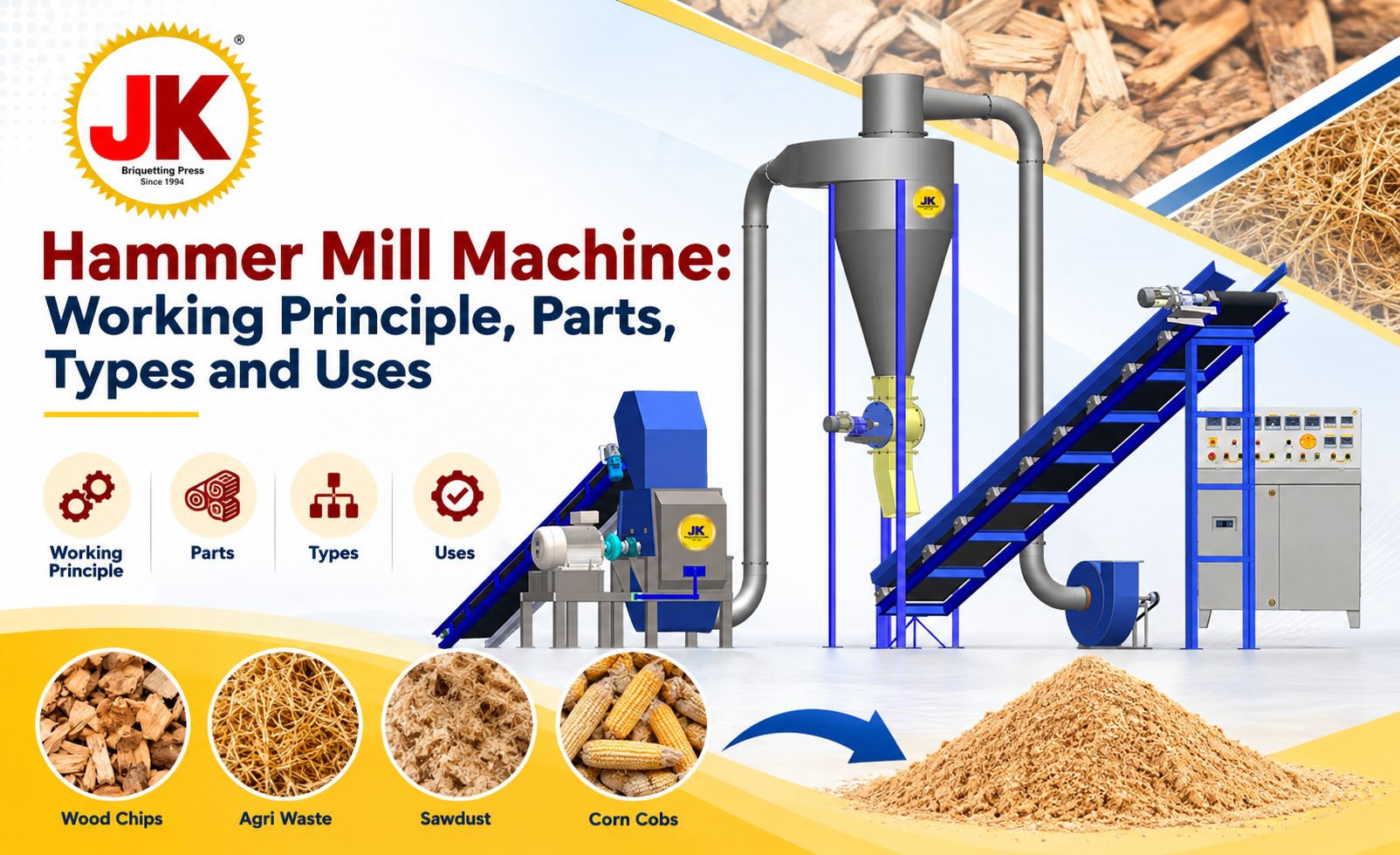
If you run a briquette or pellet plant, you already know that the press gets all the attention. But ask any experienced plant operator where most production trouble starts, and the answer is usually the same: the raw material was not ground properly.
That is the job of the Hammer Mill Machine. It takes rough, uneven biomass like groundnut shells, cotton stalks, wood chips and husk, and turns it into small, uniform particles that a briquetting press or pellet mill can actually work with. Get this step right and the rest of the line runs smoother. Get it wrong and you will see weak briquettes, choked dies and a lot of downtime.
At Jay Khodiyar, we manufacture hammer mills alongside our briquetting presses, so we see this side of the process every day. In this guide we explain how a hammer mill works, what parts it has, the main types, which screen size to use for different materials, and what to check before you buy one.
What Is a Hammer Mill Machine?
A hammer mill is a size reduction machine. Inside a closed grinding chamber, a rotor spins at high speed with a set of hammers attached to it. When material falls into the chamber, the hammers hit it again and again until it breaks into pieces small enough to pass through a perforated screen at the bottom.
The idea is simple, and that is why hammer mills are used in so many industries. Feed plants use them for grain. Pharma and chemical units use them for powders. In the biomass industry, they are the standard machine for preparing raw material before briquetting or pelleting.
How Does a Hammer Mill Work?
The hammer mill working principle is based on impact. Material is not cut or sliced. It is smashed. Here is what happens step by step.
1. Feeding
Raw material goes into the feed hopper, either by hand or through a screw or belt conveyor. A steady, even feed matters more than most people think. If you dump material in bursts, the motor load jumps up and down and the output becomes uneven.
2. Impact and Grinding
Inside the chamber, the hammers swing out because of the rotor speed and strike the material hard. The pieces also crash into the chamber walls and into each other. This repeated impact is what breaks shells, stalks and chips into small particles.
3. Screening
A screen with holes of a fixed size sits around or below the rotor. Only particles smaller than the holes can pass through. Anything bigger stays inside and gets hit again. This is how you control the final particle size. Change the screen, and you change the output.
4. Discharge and Collection
In a small mill, the ground material simply falls out under gravity. In most biomass plants, a blower pulls it out and sends it through a pipe to a cyclone separator, which drops the material and lets the air out. A dust collector catches the fine dust so it does not spread around the plant.
Main Parts of a Hammer Mill
Knowing the parts helps a lot when you are comparing machines or doing maintenance.
- Feed hopper: where raw material enters the machine.
- Grinding chamber: the heavy steel housing where grinding takes place.
- Rotor and shaft: the spinning assembly that carries the hammers.
- Hammers: hardened steel bars or plates that strike the material. These are the parts that wear out the most.
- Screen: the perforated plate that decides the particle size.
- Motor and drive: usually an electric motor connected by belts or a direct coupling.
- Blower and cyclone: move the ground material out and separate it from the air.
- Dust collector: keeps fine dust out of the working area.
Types of Hammer Mills
Not every hammer mill is built the same way. The right type depends on what you are grinding and how fine you need it.
Gravity Discharge Hammer Mill
The ground material drops straight down through the screen. These are simple, sturdy machines and are often used for heavier, denser materials.
Pneumatic (Air-Assisted) Hammer Mill
A blower pulls material through the screen and out of the chamber. The airflow stops light, fluffy material from blocking the screen, and it also keeps the chamber cooler. This is the most common setup for biomass like sawdust, husk and agro waste.
Full Circle Screen Hammer Mill
Here the screen wraps all the way around the rotor, so there is more open area for material to pass through. This gives higher throughput for light materials such as straw and grain.
Horizontal In-Feed Hammer Mill
Material is fed from the side instead of the top. These are built for bulky items like pallet scrap and wood offcuts.
Laboratory Hammer Mill
Small machines used for testing samples. They are not used for production, but they are useful when you want to check how a new raw material behaves before you buy a big machine.
Why Particle Size Matters So Much in Biomass
This is the part many buyers skip, and it is the part that decides whether your plant makes money.
A briquetting press works by squeezing material under very high pressure. If the particles are too big, they do not pack tightly, and the briquette cracks or breaks during handling. If the particles are too fine, the material can turn into dust and may not bind well either. You want a uniform size, not just a small one.
As a rough guide, most briquetting presses work best when the material is ground to around 5 to 6 mm or less. Pellet mills need finer material, usually around 3 mm. The exact number depends on the press and the raw material, so always ask your machine supplier what size their press expects.
Moisture also plays a big part. Wet material sticks to the screen and slows the mill down. Most briquetting lines aim for feed moisture of about 8 to 12 percent, which is why a biomass dryer often sits before or after the hammer mill.
Materials You Can Grind in a Hammer Mill
In biomass plants, hammer mills commonly handle:
- Sawdust and wood chips
- Groundnut shells
- Cotton stalks and mustard stalks
- Rice husk and wheat straw
- Sugarcane bagasse
- Coffee husk and other agro waste
- Bamboo dust and forestry waste
Very long or very large pieces, such as whole branches or long stalks, should go through a chipper or shredder first. A hammer mill does its best work on material that is already roughly sized.
Benefits of Using a Hammer Mill
- Uniform output: the screen keeps particle size consistent, which directly improves briquette and pellet quality.
- Works with many materials: one machine can handle different agro and wood residues with a simple screen change.
- Simple design: fewer complicated parts means easier repairs and less dependence on specialists.
- Low running cost: spare parts like hammers and screens are affordable and quick to replace.
- High capacity: a properly sized mill can keep up with a continuous briquetting line.
Common Problems and How to Fix Them
Most hammer mill issues come from a handful of causes. Here is what we see most often in the field.
Output has dropped. Check the hammers first. Worn, rounded hammers hit with much less force. Many hammers can be turned around to use a fresh edge before you replace them. Also check whether the screen is partly blocked.
The screen keeps choking. This usually means the material is too wet, or the airflow is too weak. Dry the material further or check the blower and pipes for leaks and blockages.
The machine is vibrating more than usual. Hammers should always be replaced in balanced sets. A single new hammer next to worn ones can throw the rotor out of balance. Loose bolts and worn bearings are the other usual suspects.
The motor is overheating or tripping. You may be feeding too fast, or the screen holes may be too small for the motor size. Try a steadier feed rate first.
Safety Points You Should Not Ignore
Biomass dust burns easily, and fine dust in the air can catch fire. Keep the plant clean, make sure the dust collection system is working, and never let dust build up around the motor or electrical panels.
Metal pieces in the raw material are another real risk. A nail or bolt hitting the hammers can damage the machine and create sparks. A magnet at the feed point is a cheap way to avoid this. And always switch off and lock out the power before opening the chamber for any work.
How to Choose the Right Hammer Mill
Before you ask for a quotation, have answers to these questions ready:
- What will you grind? Hard shells, soft husk and fibrous stalks all behave differently.
- How much per hour? The mill should match or slightly exceed the capacity of your briquetting or pellet machine.
- What particle size does your press need? This decides the screen and the type of mill.
- How wet is the material? If it is often above the ideal range, plan for a dryer.
- What power supply do you have? Check that your connection can handle the motor load.
It also helps to buy the hammer mill from the same supplier as your briquetting press. When one company designs the whole line, the capacities match and you have one point of contact if something goes wrong.
Jay Khodiyar: Hammer Mill Manufacturer for Biomass Plants
Jay Khodiyar has been building biomass machinery under the JK Briquetting Press name since 1994. Our hammer mills are designed for the materials our customers actually work with, such as groundnut shells, cotton stalks, sawdust, husk and other agro and wood waste.
Because we also manufacture briquetting presses, biomass dryers and wood chippers, we design our hammer mills to fit into a complete line. The mill is sized to match the press, and the screen is selected for the particle size that press needs. You are not left trying to make machines from different suppliers work together.
When you contact us, our team will ask about your raw material, its moisture, and the output you want per hour. Based on that, we recommend the right hammer mill model and screen size, and we can supply it as a standalone machine or as part of a full briquetting or pellet plant.
We also supply spare hammers and screens and support you after installation, so your mill keeps running at full output.
Frequently Asked Questions
What is the working principle of a hammer mill?
A hammer mill works on impact. Hammers on a fast-spinning rotor strike the material repeatedly until it is small enough to pass through the screen.
How do you control particle size in a hammer mill?
Mainly through the screen hole size. Rotor speed, hammer condition and feed rate also affect the final output.
Is a hammer mill the same as a pulverizer?
The terms are often used for the same type of machine. In general, “pulverizer” is used when the output is very fine, close to powder.
How often should hammers be replaced?
It depends on the material. Sandy or hard materials wear hammers out faster. Check them regularly and rotate or replace them as soon as output starts to drop.
Do I need a hammer mill for a briquetting plant?
In most cases, yes. Unless your raw material is already fine and uniform, such as clean sawdust, a hammer mill is needed to get consistent briquette quality.
Final Thoughts
A hammer mill does not get much attention, but it sets the quality for everything that comes after it. Choose the right type, match the screen to your press, keep the material dry and look after the hammers, and it will give you years of steady work.
If you are planning a new briquetting or pellet plant, or want to fix an existing line that is not giving the output you expected, get in touch with Jay Khodiyar. As a hammer mill manufacturer, we can help you pick the right machine for your raw material and capacity.